


Managing a media buying team becomes harder when the team starts running large traffic volumes. At the beginning, a team lead can still keep things under manual control: who launched which campaign, which offer is being tested, where the budget went, and which funnels are working. But as volume grows, questions start appearing that can no longer be answered in a couple of minutes: where the budget is leaking, who made the mistake, which funnels are profitable, who has access to the data, and what is actually happening inside the team.
In media buying, transparency is not an extra feature. It is a basic requirement for control. If the team lead cannot see buyer actions, access levels, and the result of each launch, the team starts being managed through chat messages, manual reports, and assumptions. With large budgets, this model becomes too expensive.
How to Evaluate Buyer Performance
Buyer performance cannot be measured only by the number of launches or leads. It is important to understand who actually brings results and who is simply spending the budget. To do that, you need data on spend, conversions, revenue, profit, ROI, traffic quality, and actions inside the system.
One buyer may launch many campaigns but regularly waste budget on weak funnels. Another may work with lower volume but deliver stable results and find scaling points faster. Without transparent analytics, these differences are easy to miss.
A team lead needs to see each buyer’s performance by traffic source, offer, geo, campaign, and funnel. Then management is based not on subjective judgment, but on specific data: who brings profit, who makes mistakes in the setup, who does not follow the structure, and who needs help with analytics or testing.
Why Access Rights Matter in a Media Buying Team
When there are several buyers in the team, access rights are no longer just a technical setting. They become part of media buying management. Each team member should only have access to what they need for their work. Otherwise, the risk of mistakes, accidental changes, funnel leaks, and uncontrolled use of internal data increases.
In media buying, a working funnel is an asset. It can include a traffic source, offer, geo, landing page, pre-lander, creatives, tracking settings, and traffic distribution rules. If access rights are too broad, the team risks not only the budget, but also the copying of working approaches.
That is why proper management should allow rights to be separated clearly: who can see campaigns, who can edit settings, who has access to content, who can view financial data, and who works only within their own launches.
Buyer Action History as a Control Tool
For a team lead, it is important not only to see the final numbers, but also to understand which actions led to them. If a campaign starts leaking budget, the team needs to quickly understand what changed: a buyer changed the settings, sent traffic to the wrong place, edited the landing page, passed tags incorrectly, touched a working funnel or launched a test without an agreed logic.
Action history helps investigate these situations quickly. You can see who did what and when. This reduces disputes inside the team and helps find the cause of the problem faster. When all actions are logged, the team lead can delegate launches calmly without losing control over the result or the safety of working funnels.
Horizontal and Vertical Access Rights
In media buying team management, it is important to separate two levels of permissions.
This model helps build a proper structure: buyers work within their areas of responsibility, team leads control the team, and the business owner sees the overall economics without the risk of extra data ending up with the wrong people.
How AIO Helps Keep Media Buying Under Control
In AIO, you can separate access to launches, data, and system sections, control every buyer’s actions, see who works with which campaigns, and evaluate team performance across different metrics.
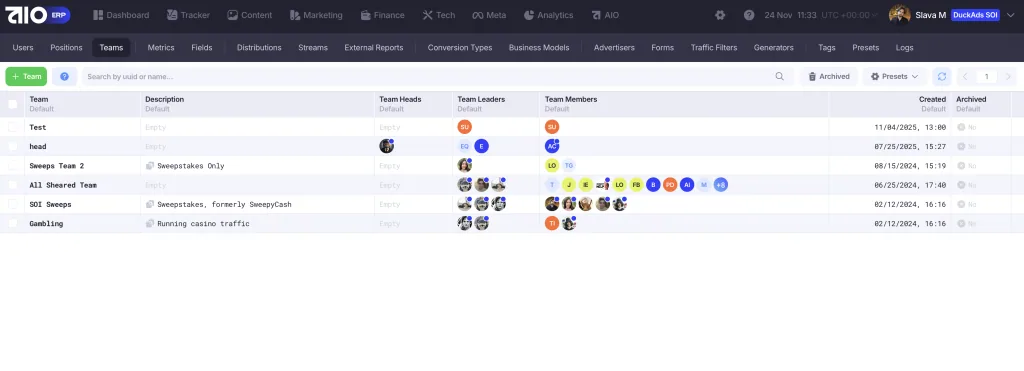
The roles and permissions system helps you do more than just “give people access”.
It helps build a controllable structure. Buyers get exactly the level of access they need for their work. The team lead sees team actions and the result of each participant. The owner understands where the team is making money and where the budget is being lost.
As a result, media buying team management becomes more transparent: fewer manual checks, lower risk of leaks, less chaos in access rights, and more control over how the team works with budget, traffic, and profitable funnels.
If you want to see the performance of each buyer, control access rights, and protect working funnels inside your team, book a demo.